
Kia Soul (SK3): If you have a flat tire (with Tire Mobility Kit) / Checking the tire inflation pressure
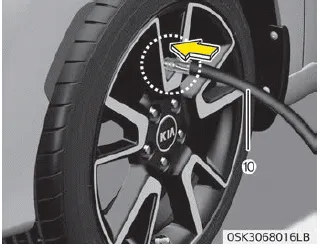
1. After driving approximately 7~10 km ( 4~6 miles or about 10 minutes), stop
at a suitable location.
2. Connect connection hose (10) of the compressor directly to the tire valve.
3. Connect between compressor and the vehicle power outlet using the cable and connectors.
4. Adjust the tire inflation pressure to 230 kPa (33 psi). With the ignition switched
on, proceed as follows.
- To increase the inflation pressure: Switch on the compressor, position I. To check the current inflation pressure setting, briefly switch off the compressor.
WARNING
Do not let the compressor run for more than 10 minutes, otherwise the device will overheat and may be damaged.
- To reduce the inflation pressure: Press the button (9) on the compressor.
CAUTION
If the inflation pressure is not maintained, drive the vehicle a second time, refer to Distributing the sealant. Then repeat steps 1 to 4. Use of the TMK may be ineffectual for tire damage larger than approximately 4 mm (0.16 in).
We recommend that you contact an authorized Kia dealer if the tire cannot be made roadworthy with the Tire Mobility Kit.
WARNING
The tire inflation pressure must be at least 200 kPa (29 psi). If it is not, do not continue driving. Call for road side service or towing.
11. Immediately drive approximately 7~10 km (4~6 miles or, about 10min) to evenly distribute the sealant in the tire. CAUTION Do not exceed a speed of 80 km/h (50 mph).
Park your car at the side of the road so that you can work with the TMK away from moving traffic. Place your warning triangle in a prominent place to make passing vehicles aware of your location.
Other information:
Kia Soul (SK3) 2020-2025 Owners Manual: Checking tire inflation pressure
Check your tires once a month or more. Also, check the tire pressure of the spare tire. How to check Use a good quality gauge to check tire pressure. You can not tell if your tires are properly inflated simply by looking at them. Radial tires may look properly inflated even when they're underinflated.
Kia Soul (SK3) 2020-2025 Owners Manual: Inner panel fuse replacement
1. Turn the ignition switch and all other switches off. 2. Open the fuse panel cover. 3. Pull the suspected fuse straight out. Use the removal tool provided in the main fuse box in the engine compartment. 4. Check the removed fuse; replace it if it is blown.
Categories
- Manuals Home
- Kia Soul Owners Manual
- Mirrors. Outside rearview mirror. Folding the outside rearview mirror
- System setting and activation
- Specifications & Consumer information
- New on site
- Most important about car
